
Introduction
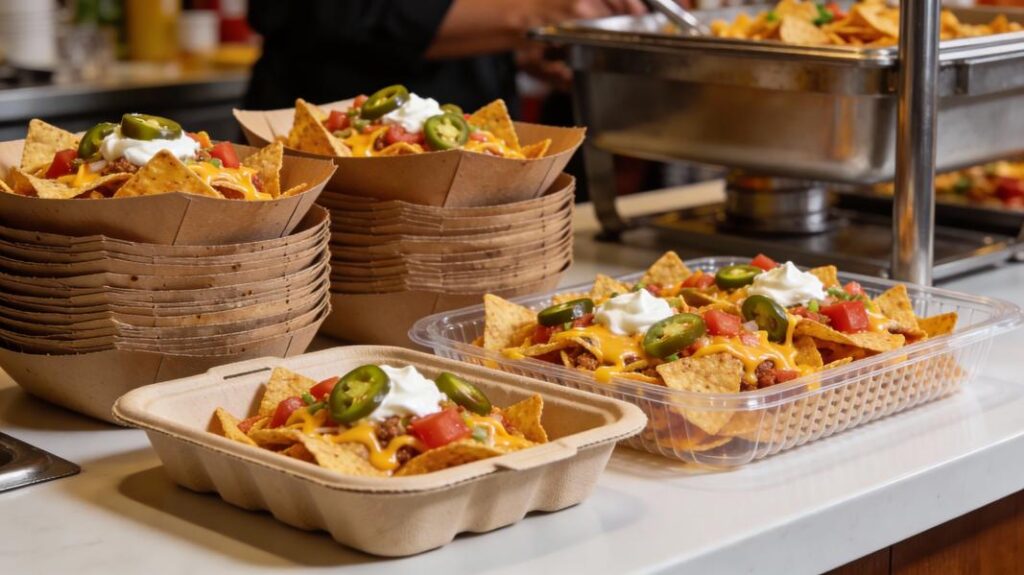
Nachos are a crowd-pleaser, but serving them efficiently requires the right vessels. Paper bowls for nachos combine cost efficiency, durability, and convenient handling for events, venues, and take-out operations. This guide helps business owners navigate material options, core features that affect performance, eco-friendly compostable alternatives, event applications, and a transparent plastics comparison. Each section is designed to build a practical framework for selecting bowls that uphold food safety, manage grease and oil, and support sustainability goals. We’ll explore available materials—from kraft paper trays to bagasse fiber and compostable composites—then highlight standout features such as grease resistance, multi-compartment designs, microwave and freezer compatibility, and bulk packaging considerations. We’ll discuss contexts where compostable options make sense for events, and conclude with a clear set of criteria for choosing paper bowls for nachos that align with brand, operations, and environmental commitments.
Tables of Contents
Chapter 1: From Greaseproof to Green: Choosing Paper Bowls for Nachos in High-Volume Service
- Material Options for Paper Bowls for Nachos: Technological Performance of Greaseproof Paper versus Molded Fiber in High-Volume Nacho Service
- Grease, Green, and Global: Economic, Environmental, and Geopolitical Dynamics of Cardboard and Molded-Fiber Nacho Trays
Chapter 1: From Greaseproof to Green: Choosing Paper Bowls for Nachos in High-Volume Service
1. Material Options for Paper Bowls for Nachos: Technological Performance of Greaseproof Paper versus Molded Fiber in High-Volume Nacho Service
In venues and events that depend on rapid, high-volume nacho service, the material that forms the serving bowl becomes a silent workhorse. The choice between greaseproof paper and molded fiber sits at the intersection of containment, handling ease, and end-of-life implications. Both options are widely used, but their performance envelopes diverge in meaningful ways as soon as heat, sauce, and weight start stacking up on a tray or during a fast-paced service window. For operators, understanding these nuances is not purely academic; it translates into fewer spills, cleaner presentation, and a clarifying lens on sustainability when guests and procurement teams ask about waste streams.\n\nMolded fiber, derived from renewable plant fibers such as bagasse or other agricultural strands, brings a distinct structural identity to nacho service. Its defining characteristic is a dense, rigid internal architecture that resists sagging and deformation under pressure. This rigidity matters in high-volume settings where nachos arrive as heavy, saucy, and unevenly loaded portions. The fiber network, often paired with compostable coatings that meet standards like ASTM D6868, creates a barrier to oil and moisture without leaning on petroleum-based linings. In practice, this means a molded-fiber bowl can hold up to heavier toppings and maintain shape through stacking, transport, and the brisk transfer from kitchen to floor to table. The same density that gives strength also supports a neater, more presentable product, reducing the risk that cheese or salsa will seep through the sides during a crowded service.\n\nEnd-of-life considerations reinforce the environmental appeal of molded fiber in intent-driven operations. When coatings are selected to align with industrial composting facilities, molded-fiber trays can break down within a predictable timeframe, returning nutrients to soil rather than lingering as persistent litter. The durability that helps with containment in service also aligns with a cycle of controlled disposal, provided local facilities exist to accept industrial compostable packaging. It is worth noting, however, that the compostability story is coating-dependent. Some coatings may require specific composting conditions and separation from conventional waste streams. For managers aiming to minimize environmental impact, this creates a practical imperative: assess local composting capabilities and ensure end-of-life pathways are clear for guests and staff alike.\n\nGreaseproof paper, by contrast, emphasizes oil and moisture resistance through surface treatments that deter penetration and staining. This focus on grease resistance can be advantageous in lighter applications or in menus where toppings are less saucy and portions are, on average, easier to manage. The trade-off appears in structure. Even with robust paperboard cores, greaseproof configurations often offer less intrinsic rigidity than molded fiber; they can sag or deform under substantial weight or with long hold times. In high-volume nacho service, where trays are stacked, moved, and frequently bumped, that reduced stiffness can translate into less reliable containment and a higher likelihood of tipping or tearing when toppings press outward.\n\nNevertheless, greaseproof variants are not devoid of end-of-life options. Some compositions are designed to be biodegradable or compostable, but the performance and degradation timelines depend on the exact coatings and treatments used. In markets without convenient composting infrastructure, the environmental advantages may hinge on regional waste management practices and consumer participation. For operations prioritizing cost and simplicity, greaseproof paper can represent a leaner option, particularly when the menu structure favors lighter servings or when the volume of saucy toppings remains within the material’s practical limits. When price pressures are tight and containment demands are moderate, greaseproof paper can be a pragmatic choice that supports high throughput without the same level of rigidity required by heavier fillings.\n\nThe decision between these two material families is rarely binary. It involves balancing containment reliability with cost, and aligning packaging choices with a realistic view of end-of-life disposal. In a setting where nachos routinely arrive hot, crowded, and loaded, molded fiber generally outperforms greaseproof paper on stacking stability and resistance to deformation, delivering a cleaner presentation and fewer service disruptions. In scenarios where the toppings are lighter, or where procurement economics dominate and the waste stream can accommodate it, greaseproof paper offers a viable, lower-cost alternative. Operators should also weigh the broader ecosystem: whether industrial composting facilities are reachable, what local regulations require for disposable ware, and how guests perceive sustainability in the context of the event or venue.\n\nFor those exploring the material landscape further, the fiber-based path has resonances with other renewable, compartment-based packaging options that leverage the same plant-fiber base. In particular, consider how the same family of materials scales into multi-compartment designs that keep chips, cheese, and toppings neatly separated, preserving texture and temperature. This broader ecosystem, including the niche options built around sugarcane bagasse and similar feedstocks, underscores a crucial point: the best choice is a systems decision, one that weighs service performance, cost, and end-of-life realities in equal measure. See how such fiber-based compartment systems align with your venue’s sustainability goals and how their design supports a reliable, scalable nacho experience. For a closer look at sugarcane-based, compartment-grade options, read about sugarcane bagasse clamshell compartment containers.
2. Grease, Green, and Global: Economic, Environmental, and Geopolitical Dynamics of Cardboard and Molded-Fiber Nacho Trays
Two dominant families shape how nachos travel from tray to table: sturdy cardboard kraft trays and molded-fiber forms. Both are engineered to resist grease and oil, yet they sit at different points on the spectrum of performance, cost, and end-of-life impact. For operators handling large crowds, the choice is not simply about keeping toppings in place; it is a strategic decision about speed, storage, waste streams, and geographic supply resilience. Cardboard kraft trays often come with a polyethylene or similar grease barrier that keeps chips from becoming a soggy mess and prevents deformation under heat. They are widely available in bulk, and their weight and rigidity make them dependable workhorses for concession stands, catering lines, and sports events. From a cost perspective they excel in low price and high volume; bulk packs and universal sizing support rapid pickup and minimal changeovers during peak service. In many operations, the simplicity of cardboard—easy to stack, easy to dispose of with general waste streams where permitted—keeps service flowing even when staff turnover is high or the line moves quickly. Yet the grease barrier, while essential, also signals a trade-off: the coating tightens the tray’s performance but can complicate compostability in settings that emphasize anaerobic digestion or home composting. That is where the molded-fiber option enters the narrative with a different set of advantages and constraints.
Molded-fiber trays, formed from virgin fibers, hemp, or other plant-based inputs, push the environmental case further along the spectrum. The same moisture barriers that protect nachos in a hot cafeteria tray can be achieved with plant-based coatings, which may improve end-of-life outcomes compared with traditional plastics. Molded fiber tends to offer superior compostability and recyclability, aligning with sustainability goals that look beyond recycling alone. The environmental story here is reinforced by several compelling metrics: hemp-based fiber variants can reduce CO2 emissions by substantial margins, and some molded-fiber options are certified for home composting or commercial composting, while avoiding PFAS and other synthetic contaminants. This combination of performance and end-of-life clarity resonates with institutions and events seeking tangible reductions in their waste footprints. The trade-off, however, often shows up in upfront cost and storage considerations. Molded-fiber solutions can demand higher unit prices and may require more careful inventory planning, especially in climates that stress material integrity or in facilities without robust composting infrastructure. Still, the storage efficiency of molded-fiber systems—sometimes cited as 25% or more in specific supply-chain configurations—helps offset some of the per-unit cost when volumes scale, and wholesale arrangements can unlock favorable shipping terms that reduce total landed costs for large operators.
Beyond the economics, the geopolitical dimension of these materials shapes risk profiles for service providers. Cardboard pulp is a globally available commodity, with supply chains that can weather regional disruptions but may feel the tug of tariffs and wood-piber constraints. Molded-fiber, particularly when rooted in regional fibers such as hemp or bagasse, can bolster supply-chain resilience by localizing portions of production. In practice, this means operators with access to regional fiber networks can reduce exposure to distant plastics-based inputs and the political frictions that accompany them. The resulting mix—cardboard for cost-conscious throughput and molded-fiber for sustainability-forward events—reflects a pragmatic approach to sourcing in a world where plastic restrictions and waste-management policies continue to evolve. The regional narrative is complemented by certifications and standardization efforts in the EU and other markets, which guide manufacturers toward materials that align with regulatory expectations and consumer expectations alike. In short, a well-structured portfolio of paper-nacho solutions can offer a hedge against both price volatility and waste-management policy shifts.
As operators weigh the options, they often seek a pathway that respects both performance in the kitchen and responsibility at disposal. For many venues, a blended strategy proves most effective: cardboard trays for high-speed, high-volume service under tight cost control, and molded-fiber trays for events that prioritize compostability, regional sourcing, and long-term environmental goals. For nacho service at scale, this pragmatic balance translates into a more resilient supply chain, clearer end-of-life narratives, and a customer experience that sustains flavor without compromising the planet. To explore concrete material journeys that blend pulp, bagasse, and plant fibers—alongside real-world logistics and disposal outcomes—one can examine production pathways that emphasize fiber-based, compostable solutions while maintaining the efficiency needed for large crowds. Such pathways invite operators to consider not only what keeps chips crisp, but what keeps communities cleaner and waste streams simpler in a world increasingly attentive to circularity. For further insight into fiber-based options and bulk availability, see the factory-scale, wholesale, bagasse and pulp pathways described in industry discussions that emphasize sustainable packaging ecosystems. factory wholesale disposable pulp sugarcane bagasse box
Final thoughts
Paper bowls for nachos offer a versatile, cost-efficient, and scalable solution for food-service operators and event organizers. By understanding material options, you can select vessels that balance grease resistance, durability, and user experience. Eco-friendly compostable choices align with sustainability goals without sacrificing performance, while a clear comparison with plastic trays helps you optimize for guest satisfaction and cost. When paired with the right supplier, paper nacho bowls can streamline operations, support branding, and reduce environmental impact across diverse serving contexts.
Choose our reliable disposable tableware and packaging solutions for your business. We offer quality products that meet safety standards, with fast delivery and flexible options. Partner with us today to elevate your service – contact our team now for a tailored quote!
About us
We specialize in manufacturing and supplying disposable tableware, packaging paper, and boxes. With years of experience, we prioritize safety, durability, and eco-friendly practices. Our goal is to provide businesses with trusted, cost-effective solutions backed by responsive customer support.